
Guildford-born 2nd Lt Frank Fleming, missing since April 1918, now has his name on his grave in Belgium, 108 years on. How a member of the public found him.
A Guildford-born officer who went missing in Belgium in April 1918 has had his name put back on his grave, 108 years after he died.
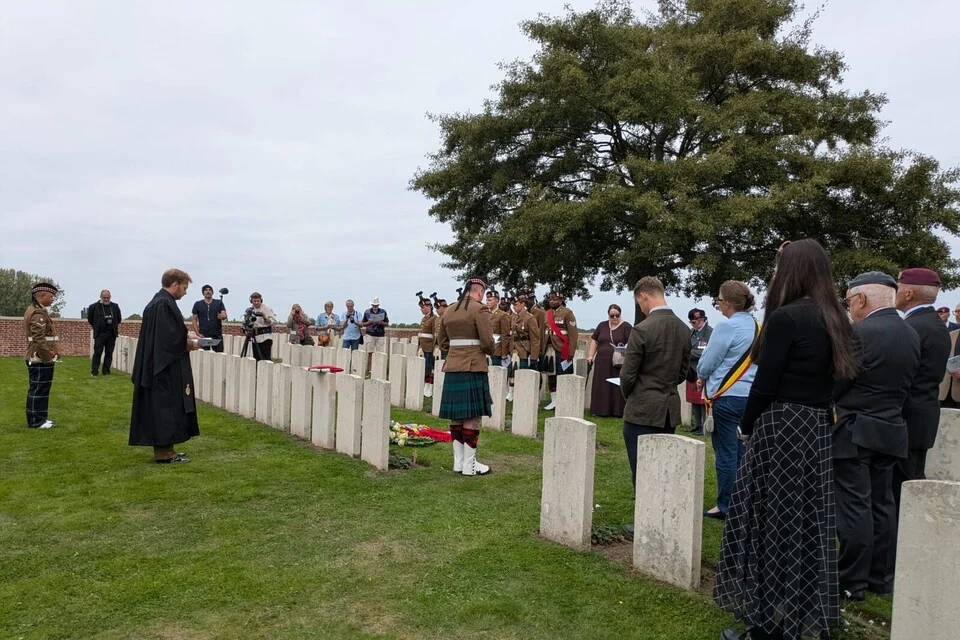
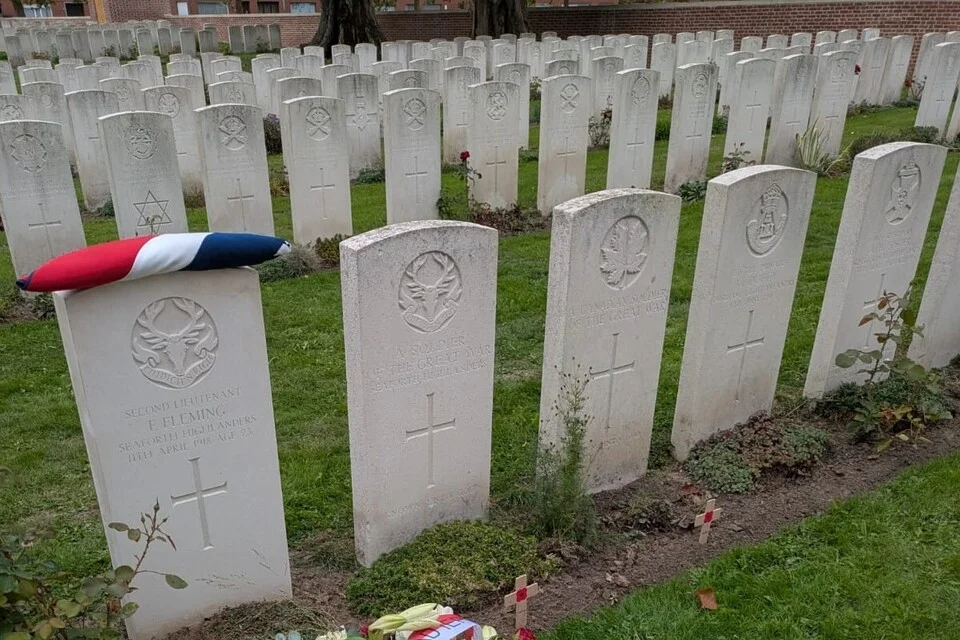
Second Lieutenant Frank Fleming of the Seaforth Highlanders had been commemorated only on the Tyne Cot Memorial, among the missing. His grave was rededicated in his name on Tuesday 22 September at the Commonwealth War Graves Commission’s Voormezeele Enclosure No. 3, near Ypres (Ministry of Defence, 24 September 2026).
The service was organised by the MoD’s Joint Casualty and Compassionate Centre, known as the “War Detectives”. Soldiers from 4th Battalion The Royal Regiment of Scotland took part.
Who he was
The MoD’s account of his life:
- born in Guildford on 15 October 1894
- grew up on his family’s farm, then moved to London to work as a market clerk
- joined the Army and was commissioned into the Seaforth Highlanders
- one of three sons of Alexander and Mary Fleming. All three brothers died in the First World War.
How he died
During the German Spring Offensive, Fleming was attached to the Seaforths’ 7th Battalion near Hollebeke, south of Ypres. On 11 April 1918 he was seriously wounded leading an attack on German positions.
According to the MoD, he ordered his men to withdraw to safety and refused to let stretcher-bearers risk their lives to reach him. He could not be recovered and was listed as missing. His new headstone gives his age as 23.
How he was found
He was not found by the Army. A member of the public researched the case and sent it in. That research showed Fleming had been buried near Hollebeke and moved to Voormezeele after the war, into a grave with no name on it.
The CWGC has now replaced the headstone with one that carries his name.
“More than 100 years after his death, it was an honour to be there today to pay tribute to Frank’s bravery and sacrifice,” said Nicola Nash, the JCCC caseworker.
Catherine Nell, the CWGC’s identifications manager, said the commission would “continue to care for his grave, alongside his comrades, in perpetuity”.
What it means for you
Fleming’s name is not lost from the record: it was always on the Tyne Cot Memorial. What changes is that there is now a grave with his name on it, which relatives and visitors can stand at.
This case was solved because a member of the public did the research. You can look up anyone the CWGC commemorates, including those listed among the missing, with its Find War Dead search. If you have family from Guildford who served in either world war, it is a good place to start.
Have your say